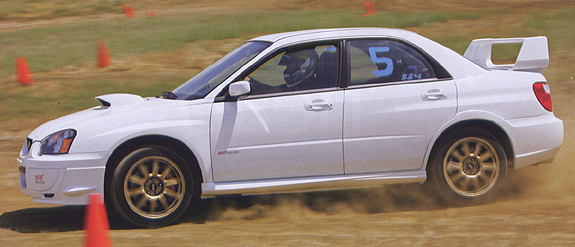
The format is straightforward – like autocross. Transplanted into a field it’s called RallyCross. Like autocrossing, each competitor completes multiple runs as quickly as possible without knocking down the course marking cones. The formats diverge in scoring – at an autocross, only the best recorded run counts. RallyCross mimics stage rally. All of the runs count towards a cumulative time, so you can be leading your class, make a mistake on your final run and hurt your overall position. Steady and smooth driving can really pay off at the end of the day.
SCCA’s San Francisco Region owns and operates Thunderhill Raceway Park, just west of Willows California. A gradually sloped field near the track’s access road serves as the region’s home site. I talked with (at the time) RallyCross Chief Skylar a couple of years ago. Stein got involved at its inception in Northern California. “I bought a Subaru WRX in March of 2002, and I wanted to do something fun. I started to autocross, because that’s all there was to do. The first RallyCross in this region was in July of ‘02. I came out to that, and came away saying – damn, this car just wants to be in the dirt.”
Compared to other events under the SCCA umbrella, RallyCross is its own animal. A set of national rules recently appeared, and there’s been talk of a national runoff, but it hasn’t advanced past that. Stein explained, “We actually run the California Rally Series (CRS) classes. They’ve been around a long time – running events out of Southern California. Several of our events even pay points into the CRS championship.”
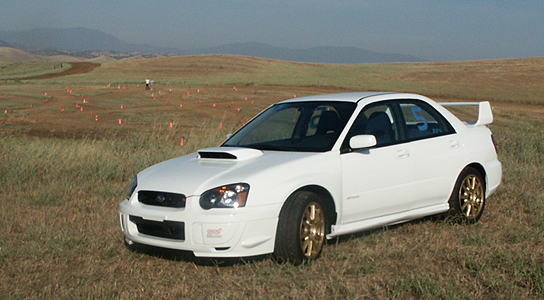
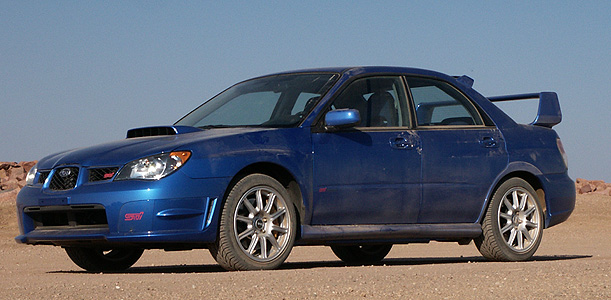
There’s no need to flip through a two-inch-thick car-classification book, as the CRS rules are pleasantly simple. Essentially three classes are split into two and four wheel drive categories. Street Stock, Street Modified, and Open. Put rally tires on the car and it’s in the open class. Period. Street tires are defined by a measurement of the non-circumferential sipes (cuts) between tread blocks. Roll bars and cages are encouraged, but not required, except on trucks. My STI (well it actually belonged to Subaru) with its sticky (on tarmac) Bridgestone RE 70’s slotted into Street Stock 4.

Registration was a breeze; hand over some money, show them your helmet, (loaners are available also) and pick up a tech card. The inspection was a self-performed checklist of common sense items like battery hold-downs, wheel play, and loose items in the car. Before things get started, competitors walk the course to learn the sequence of turns and speculate how bumps, ruts, and irregularities might influence potential fast lines. While walking, I ran into Mark Anton and Mike “Boomer” Malsed. They became friends years ago racing remote control cars. “I was spending more than $4k a year on R/C cars.” Boomer said. “Mark tried RallyCross with his Ford Probe and was hooked - told me about it – so I went out and bought a Honda Civic for a grand.” Sounds like a good thing to do with a $1k car to me.
A brief driver’s meeting explained the running order and the rules. Timing is recorded on a rally clock in hundredths of a minute. Each cone toppled adds two hundredths to your time, and if you DNF a run – by going off course and rejoining somewhere else- the slowest run of the group plus two-tenths is recorded. Jump the start and expect a .1 penalty. All drivers must share the workload; shagging cones, manning flags, or working the timing equipment or face disqualification. Each run group starts with a parade lap of all the cars, to give drivers a chance to see the course from behind the wheel, and if there’s time at the end of the day, fun runs are a buck each.
Looking across the impromptu paddock, it was a sea of Subarus. Roughly half of the cars were “Subies” several of which were fitted with full WRC (World Rally Championship) replica roll cages. The balance of cars ranged from a stock Ford Focus and Dodge Neon to a rally-tire shod 1973 Mini Cooper all the way up to full-blown stage rally cars like the Volkswagen Corrado of Viet-Tam-Luu. Luu started out rallycrossing last year in a Mitsubishi Lancer EVO, and switched to the fully prepped VW earlier this year.
RallyCross regular Pete Cowan designed the course. He laid it out on a giant sheet of paper with a scale model car, and spent Friday afternoon setting up the real course for Saturday’s event. “I tried to mix it up with technical sections and some longer straights to equalize the cars.” Pete’s technical section referred to back-to-back u-turns that looked tighter than our STI’s turning radius. (That’s tight.) Ultimately, Cowan took top time of day with his own open class Subaru STI.

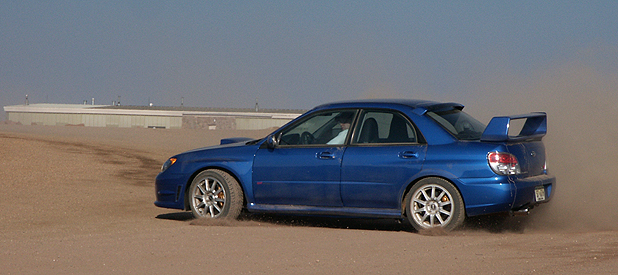
The actual seat time is fleeting, but it’s adrenaline packed. Typical times hovered around a minute and a half – giving most competitors about five minutes behind the wheel. Even though you’re only in first and second gear, relative to the size of the course, you’re covering loose ground quickly. It’s busy behind the wheel, as you toss the car with opposite lock from side to side, and maybe a dash of e-brake to initiate rotation on the tighter stuff. My first runs were pretty clean, and I felt like I was sliding the car a bit. I tried different settings on the adjustable center differential to get a sense of nuances in power delivery when it was doled out at varying percentages front-to-rear. For my last run, Travis Brock hopped into the car and said, “Hey can I ride along?” Brock is a member of the “Gravel Crew”, a group of rallycrossers from Southern California who compete for points in CRS and put on their own CRS sanctioned rallycrosses. (you may be familiar with his father, sports car and Datsun 510 legend Peter Brock.) My own rear wheel drive road racing style became apparent as Brock instructed me how to use the throttle and four-wheel drive to pivot the car around the tight corners. His instruction to “Hit the throttle” would come as I was just gathering the car into the corner. I obliged, and the STI rotated itself sideways and leapt forward as if it instinctively knew where to go.

I rode along with Brock in his own normally aspirated Subaru 2.5RS for a humbling ride with an experienced driver on Pirelli P Zero Gravel rally tires. Despite a general lack of interior and full WRC style cage, it serves as his daily street driver. He tapped his right foot until the last few hundredths of the start countdown and we were off in a hail of spinning tires and shooting rocks. Aside from the phenomenally improved grip afforded by the rally tires, I was impressed at how much he used weight transfer to pivot the car in the tightest corners – even before using the hand brake, it felt like the back of the car was up in the air, and the fronts were hunkered down grabbing the dirt. Brock finished second in class and overall.
Most of the competitors I talked with had been involved with RallyCross between 1-3 years. Some were hooked by rally video games. Others found out about it through the SCCA memberships that came with their new Subarus. The CRS contingent from the south had a heavy influence from off-road desert truck racing. Brock’s buddy John Jimison sold his full-blown rally car when SCCA pulled out of sanctioning special stage rally events at the end of 2004. “I’m one of the guys that freaked out, before we found out the events would continue under new sanctioning bodies.” He’s also got a D1 drift license to fall back on. While some were set on RallyCross as the destination, many are looking to hone dirt skills they could take into performance rallying.
It’s also a great place to shake a rally car down without getting stuck in the woods. Jack Maranto was into SCORE off-road trucks before he got involved three years ago through a friend at the Ridgecrest Rally School. “The first year we ran the whole season in rental cars – a different car each event. Last year I ran the first ¼ of the season in rental cars, and won my class.” He was running an STI that was piece by piece evolving into a fully prepped rally car. It’s backdated with 15” wheels and gravel tires, a steering rack with fewer turns lock-to-lock, and a giant hand brake right next to the steering wheel that simultaneously cuts power to the rear diff. “Sometimes rally guys like Leon Styles and Rhys Millen come out to our events, and we can beat them. It’s all about the cleanest line, smooth is fast. You’ve got to remember – in like a lamb, out like a lion.”

On average, turnouts hover between 40 and 60 cars as the program continues to gain momentum. The atmosphere carries over from rally - it’s low key and competitors are friendly and eager to help newcomers. “It turns out that not everyone wants to get their cars dirty.” Stein said, but for those who are willing, playing in the dirt has a whole new meaning.