Showing posts with label Subaru WRX STi. Show all posts

Tuesday, June 10, 2008

Notes from comparing the 2008 Mitsubishi EVO, Subaru STI, VW Golf R32, and BMW 135i


On a recent comparison article for Sports Car International Magazine written by Alex Palevsky, I was tapped to drive the cars and offer my input. Here are my thoughts:

EVO X MR
As a “driver’s car” the Mitsubishi Lancer EVO X MR delivers the most positive feedback of the bunch, and despite the efforts to add a little refinement, the soul of the EVO is left intact. The razor sharp steering, the overall grip, the chassis’ willingness to change direction puts the EVO squarely on top. That said, it lacks a little of the EVO IX’s explosive feel – a tradeoff clearly made for everyday drivability. The styling is controversial – it seems more cluttered than the concept, and the front end suggests a fish with an overbite when viewed from the side. At the limit the chassis balance tips from neutral to rearward, making it easy to place, slide, and gather up. The sport-auto mode on the transmission is very intuitive, and does a good job of keeping the revs right where you want them when attacking a curving road – when operated in paddle mode (Ferrari-style with fixed paddle locations that don’t get lost with a turn of the wheel) the shifts are quick and positive. The car feels far more nimble than a trip to the scales would suggest.


Subaru WRX STI
The flares and optional wheels turn the otherwise bland WRX into a smoothly aggressive package – worthy of its WRC heritage. I desperately want to like the car – the power is definitely spot-on, and like the EVO, the ride has been refined to deal with everyone’s inevitable interaction with freeways. The problem here is that softening the suspension has amplified an issue I’ve always had with the STI (on the road) with the front differential. On and off throttle produce different turning arcs – step on the throttle and it wants to straighten out, lift off and it tightens up. This STI’s steering feels more numb than previous versions, and with a softer platform underneath it, it amplifies the effect to the point it impedes my ability to place the car accurately on the road. From previous experience, had off-road ability been on the menu for our test, the new STI will cover ground like no other car, and the front diff issue doesn’t rear its head off the tarmac. When pushed, the default is understeer – surprisingly the best way to combat it is to allow the DCCD computer to make it’s own decisions about where to distribute power in the AUTO- setting.


VW R32 Golf
For me the competence of the Golf was a huge surprise. This was by far the easiest car to bring to the limit, which was unexpectedly high. When cornering hard, the chassis is totally consistent no matter what the surface, or road camber. Drive it like a front driver with a heavy right foot – if you overcook it, a slight lift of the throttle will tighten the line and noticeably pitch the rear end a few degrees. Unlike the EVO, you can feel the car’s weight working the shoulders of the front tires hard when really hoofing it, and it was clearly the least powerful of the foursome. The DSG transmission is the smoothest of the paddle-auto shifters here, but I tend to get lost on the wheel-mounted paddles. The Golf also had the stiffest freeway ride of the bunch. The exhaust note is the least refined of the bunch.

BMW 135i
The motor is the class of the field – I was blown away by the powerplant and its lack of turbo lag when I last drove the 335i in Austria, and it’s just as smooth and silky in the 1 Series. It howls like a straight six, and has a little less weight to pull around than in the 3, making it even better. Driving to our showdown from Northern California, we thought this might be the ringer – it feels so right on the open road and around town – tight, crisp, and balanced but not harsh. With rear wheel drive and near 50-50 weight distribution, editor Eric Gustafson thought it might be like bringing a gun to a knife fight, but it turns out there are a few compromises that make it more tricky to drive near the limit. The suspension tuning that makes it so good on the open road and around town can seem unsettled long before you reach the adhesion limit of the tires. In long corners, especially when on even throttle with the weight of the car evenly balanced, it seems like the shock valving creates a slightly unstable feeling front-to-rear oscillation, and if you proceed further it funnels into understeer. In playing with it, the chassis (with this shock valving) wants the weight to be transferred to the rear on the throttle, or to the front under braking. So the closer you get to driving really hard with no compromises – you’re either accelerating or hauling it down – continually pushes that instability further into the background. When you lose grip, it will be at the front, and the BMW is slower to respond to throttle changes to pitch the rear and tighten the line than the other three. While I found it tricky at first, it was also rewarding to figure it out and make it work. I like the looks, and the size – it feels like the E36 BMW, and it has a simple, straightforward interior that you can reach across and almost touch the passenger’s door panel (like the original 1600/ 2002). There’s room for improvement in the suspension tuning.

Ranking –
1 Mitsubishi EVO MR
It does it all, it’s still razor sharp, with a little comfort. The motor sounds a little like a miniature UPS truck – but who cares? Fast, and fun.
2 BMW 135i – Love the motor, and silky daily driving experience. Despite the handling nuances, I enjoyed figuring them out and always wanted back into the BMW…
3 Golf R32 –Totally consistent chassis with high approachable limits – surprisingly fun to drive, and how often will you be drag racing these other three anyway?
4 Subaru WRX STI – wanted to love it, it’s got the power and the looks, but the steering made it feel like I was sailing instead of driving.

Monday, March 17, 2008

Mitsubishi EVO X MR is still quite a driver's car


The new Mitsubishi Lancer EVO X MR is still a driver’s car, and despite the efforts to add a little refinement the soul of the EVO is left intact. The razor sharp steering, the overall grip, the chassis’ willingness to change direction puts the EVO squarely on top when compared to the ’08 Subaru STI. That said, it lacks a little of the EVO IX’s explosive feel – a tradeoff clearly made for everyday drivability.


The styling is controversial – it seems more cluttered than the concept, and the front end suggests a fish with an overbite when viewed from the side. But who cares, because at the limit the chassis balance tips from neutral to rearward, making it easy to place, slide, and gather up. The sport-auto mode on the transmission is very intuitive, and does a good job of keeping the revs right where you want them when attacking a curving road – when operated in paddle mode (Ferrari-style with fixed paddle locations that don’t get lost with a turn of the wheel) the shifts are quick and positive.


The car feels far more nimble than a trip to the scales would suggest too, and the seats make you want to hop in roll for hours.


At the Mitsubishi Design Center, the EVO in the reflection of the Eclipse design study in the window...


We played with the EVO and the STI on smooth winding desert roads, in the same situations the STI is more prone to understeer, and lacks the positive steering feel of the Mistubishi. It’s still quick across the road, and on bumpier surfaces, or off road it may have an advantage. Both of these cars have been re-tuned for better ride quality, and the optional wheels make all the difference on the STI in the looks department.

Tuesday, February 5, 2008

STi, STI, or STI? 2005, 2006, and 2008 - which one?

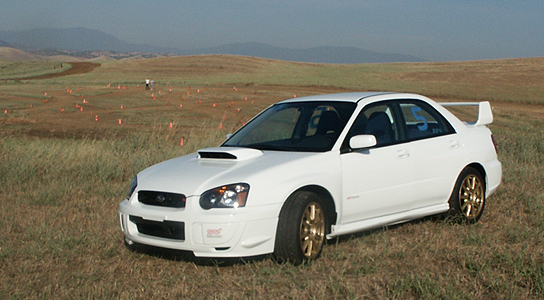
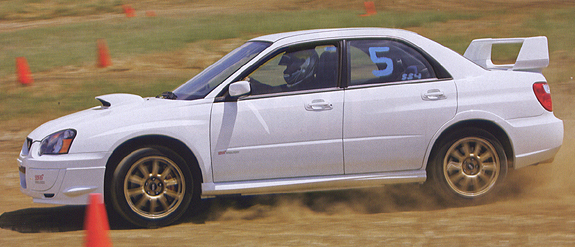
I’ve had the privilege of driving a number of Subaru’s rally bred sedans in all conditions for Sports Car International magazine. A couple of years ago I took a 2005 STi and ran it in a local SCCA Rallycross event, did some dirt roads, and some aggressive backroad driving. Following that, I covered the launch of the 2006 STI (note the capitalization of the “I” for 06 and beyond) and drove it up Pikes Peak under closed road conditions just like the hillclimb event. Later in the year I was also able to spend time with the ‘06 both on and off road. A couple of weeks ago I was fortunate enough to put some miles on the 2008 STI with its revised hatchback styling. So which one do I like best? I have to admit, for the sheer fun of driving, it’s tough to beat the ’05.

(above - 2005 STI near Willows, CA)

Let’s cut to the chase. All of these road-going rally cars are really quick for the money, and generally fun to drive both on and off of the pavement, but surprisingly each version has a distinct personality when pushed towards the limits of adhesion. A big portion of the character of these cars depends greatly on one complex piece of equipment – the center differential and how it apportions torque around the car for changing grip conditions. Everyone I talked to about the 2004 STi seemed to be in general agreement that the way it distributed torque made it a little too front biased – or understeery. For 2005 the factory played with the Driver Controlled Center Differential (DCCD) and allowed for a more rear-biased torque split of 35/65% front/rear. Keep in mind all of the versions will throw 50% of torque at the front wheels in the locked settings, or as needed when grip is low and the center diff is set in the automatic settings.

So on the road, with the diff settings all the way back, the 2005 STi behaves more like a rear drive car and rotates the rear end more generously than subsequent versions. The center differential was an electronically controlled unit – taking data from yaw sensors and wheel speed to calculate the variable torque distribution (when not locked) and wasn’t totally without fault. When driving the 2005 STi in quick back and forth switchbacks – throwing its weight quickly from side to side, as the car transferred weight, I experienced a rubbery feel as the car changed the torque distribution based on the yaw sensor and grip level at each wheel. It was like the torque delivery was a fraction of a second behind, and as a result the car felt like, just for an instant, the tires were under-inflated and it would move on the sidewalls. As soon as the torque split adjusted itself as the car loaded up, it felt normal again. At the time I didn’t realize what was happening exactly, but knew that it felt odd for a split second in that no-mans-land while the weight transferred from side to side on grippy surfaces. Most cornering didn’t bring out the trait.


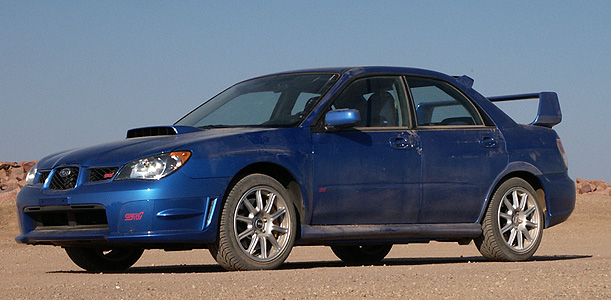
(above, 2006 STI on Pikes Peak)

Later on, (at the launch of the 06 car) I talked with Subaru’s engineers about the phenomenon, and they explained that there was a slight lag in the impulses sent to the electronically controlled center diff that distributed the torque. This prompted the change from the electronically activated unit to a mechanical center diff for 2006, with revised torque splits. In aggressive driving, the mechanical diff did the trick to eliminate the weird delay, but two more center diff changes for 06 slightly mellowed the STI’s character. Torque splits front/rear were also moved forward a bit to 41/59, and a new steering sensor added steering data to the mix of information used to distribute the torque.


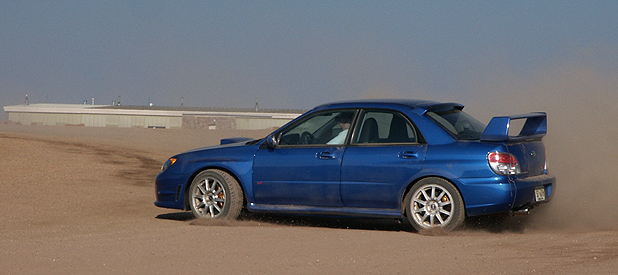
Heading down Pikes Peak in the '06


When the pavement ends, the steering sensor really comes into play. On the ‘05 version the throttle could be used to kick the car around sideways, then the yaw sensor would yell at the computer to throw the power to the front – making dramatic power slides look easy. The 2006 STI knows which way your wheels are pointed, the forward transfer of power happens sooner, and it squares itself up from a slide more quickly. So for dramatic looking drifts, you’ve got to rotate the car as it enters the corner by trailing off the throttle and allowing it to rotate – then apply the throttle and let it claw its way out. Off road, you should be doing this anyway – but I felt a little more comfortable pushing the 06 STI harder on the loose stuff.


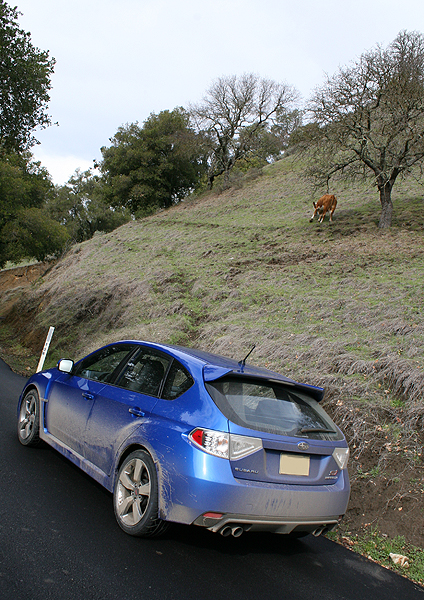
2008 STI

2008 STI


For 2008, the STI was redesigned as a five-door hatch. It looks and feels bigger, and from the outside in base trim, the wheels evoke a Pontiac Vibe feel at first glance. (To get the cool gold rally-look spoke wheels you’ve got to order the navigation package, putting your 35k STI dangerously close to the $40k mark.) The platform is softer, and has more body roll than the ’05 or ’06. On the pavement, the best cornering feel (pulling the car out of understeer most rapidly) is achieved with the center diff set in one of two auto settings, and even when the torque bias is set (manually) rearward I encountered lots of mid- corner understeer. I’ve read that the manual setting will deliver up to 25/75% torque front/rear, but the softer platform keeps it from feeling that way. The one time I was able to rotate it on-throttle from a stop, when the body roll maxed out, the car shot forward, where you could continue to drift in the previous versions. Quicker? Perhaps, but for me the setup compromised the “fun” factor. The additional body roll and softer shock bump may ultimately give the car more grip, but it loses a bit of that tossable feel during quick direction changes too. Off the road, it’s the most capable of the three in terms of covering ground quickly, and posts slightly better acceleration and slalom numbers than its predecessors.

In the end, I had the most fun with the ’05 STi, despite any time lag from the electronic diff for its willingness to slide, hang there for a bit, then claw itself out. Plus I think the grill and front-end treatment is the easiest of all of them on the eyes. All three have the same torque related issues with the front differential, making the car turn into a corner slightly differently on and off throttle – if razor sharp steering is your biggest hangup, the Lancer Evo has a leg up in that department. If ride quality is an issue, the newest version is the most refined of the bunch.


2005 STi